Protecting the Wilderness – Coastal Weeds Project
Keeping one of Australia’s most spectacular coastlines free from invasive weeds.
The Coastal Weeds Project, began in 2007 with a simple premise: the Bega Valley’s coastline was one of the least weed-degraded coastal landscapes in south-eastern Australia. Early intervention and coordinated weed control could protect this natural advantage, while delivering significant environmental, social and economic benefits.
What began as a NSW Environmental Trust-funded project has grown into a long-running, landscape-scale partnership involving Far South Coast Landcare Association, Bega Valley Shire Council, Eurobodalla Shire Council, South East Local Land Services, National Parks and Wildlife Service, the Marine Estate and local Aboriginal Land Councils and coastal Landcare groups.
A coast-wide approach
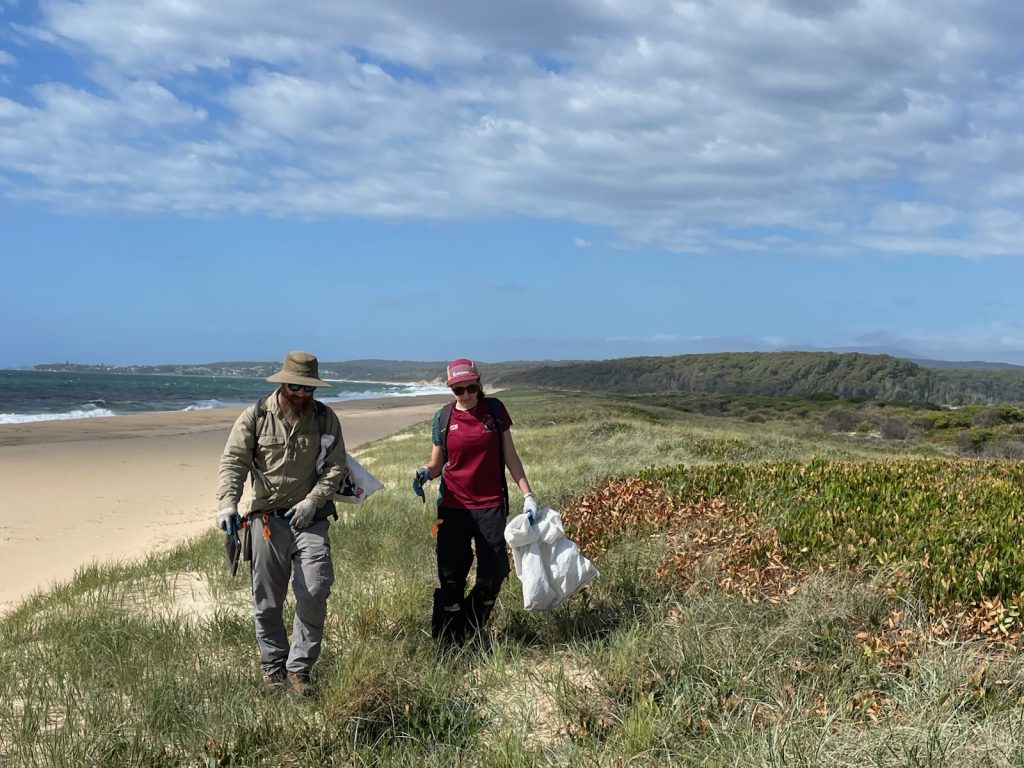
The project takes a tenure-neutral approach, recognising that weeds don’t stop at the boundaries. Twice each year, the project coordinates 10-week coastal sweeps across 144 beaches from the Victorian border through to Broulee in Eurobodalla, working with crews from local Aboriginal Land Councils, bush regen contractors and volunteers to map and remove priority weeds.
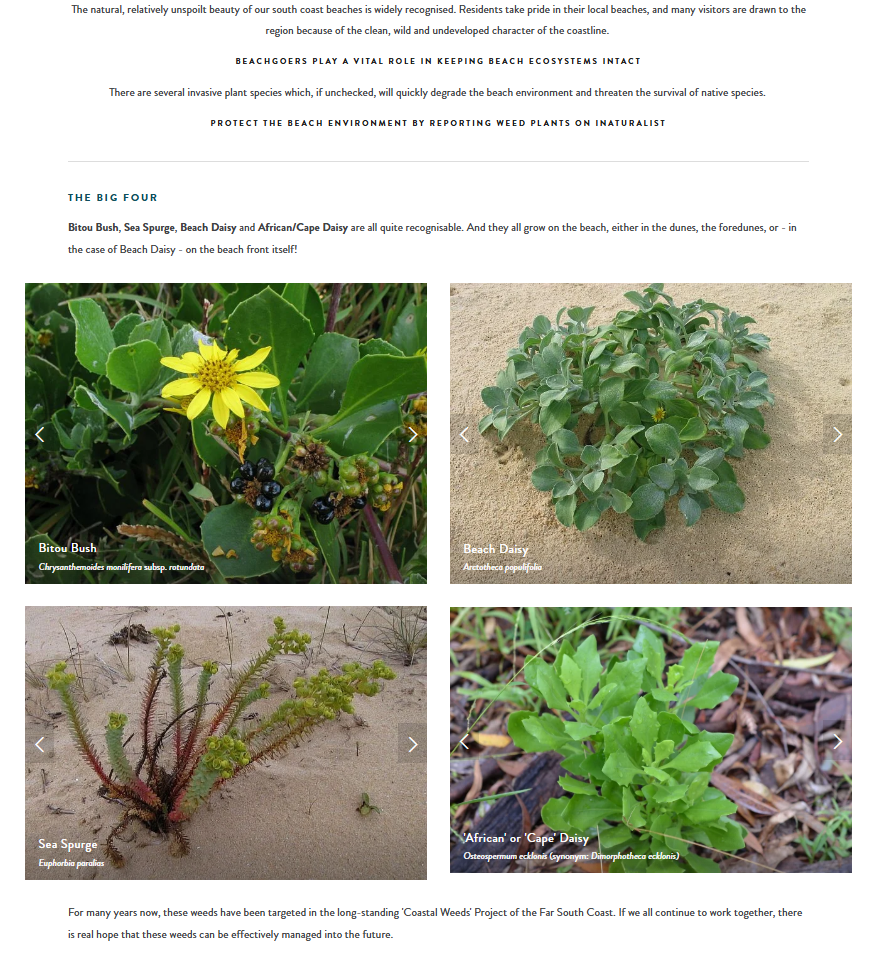
The focus initially centred on major coastal threats such as sea spurge, beach daisy and bitou bush. Through sustained monitoring and control, these weeds have been dramatically reduced across the project area. This success has freed up Landcare volunteers to tackle other restoration priorities, while the project has expanded its focus to weeds including lantana, African boxthorn, sharp rush, onion weed, and others.
The sweeps now also include marine debris collection, adding another layer of protection for the coastline and providing valuable information to support ongoing management.
Connecting people, knowledge and action
FSCLA hosts the project and employs the Coastal Weeds Project Officer, who coordinates the sweeps, monitors emerging weed threats, maps infestations and works closely with our partner agencies to prioritise on-ground action.
Where weeds occur in steep, hazardous or otherwise inaccessible locations, specialist contractors are engaged to safely undertake control works. The project also provides advice and support to local Landcare groups, helping them develop targeted weed management and restoration programs.
Stopping the next weed invasion is just as important as tackling the weeds already here. The project works with the community to build awareness of invasive plants, where they come from and how quickly they can spread. Through education, encouraging the use of the iNaturalist app, practical advice and targeted communication, we’re helping turn the whole community into an early-warning network for emerging coastal weeds.
A proven model
After almost two decades of coordinated effort, the results are clear. Sea spurge and beach daisy, once widespread and a major threat to our coastal dunes, are now vastly less common across the project area. Other high-risk weeds have also been contained or significantly reduced before they have had the opportunity to become widespread.
The project demonstrates what can be achieved when government agencies, Landcare volunteers, councils and the community work across tenure boundaries towards a shared goal.
Find out more about coastal weeds and how you can help:
Atlas of Living Australia – Coastal Weeds Project resources
For details on the key weeds and how you can get involved please see this link to the Atlas of life
Check out our Coastal weeds video - link here
NOTE: Vital funding has been secured for this project thanks to Bega Valley Shire Council, SE Local Land Services, National Parks and Wildlife, Eurobodalla Shire Council and The Marine Estate.
 Luke Hamilton with a ute full of sharp rush removed from Bithry Inlet
 Luke Hamilton with Stuart Cameron discussing weed mapping/GPS on the ipad

Key target weed - sea spurge
Very significant progress has also been made in controlling bitou, boneseed, lantana, boxthorn, pampas grass, mirror bush and crofton weed, all species with the potential to massively degrade local environments but present only at a few 'bridgehead' sites locally. A current survey has established that major progress has been made in controlling these species in the past year.